How to Make a Study Plan for an Exam (That You'll Actually Follow)
Most study plans fail by week two. A step-by-step guide to building an exam study plan from your syllabus, sized to the time you really have, with room for review.
Published 4 min read

Making a study plan is easy. Following it is hard. Most plans collapse within two weeks, for predictable reasons: they're too optimistic, they forget about review, and they don't adapt when life gets in the way.
This guide walks through building an exam study plan that survives contact with reality — from your syllabus to a daily target you can actually hit.
Why study plans fail
The planning fallacy
People consistently underestimate how long tasks will take — even when they know they've underestimated before. In Buehler, Griffin and Ross (1994), students predicting when they'd finish their thesis were, on average, much too optimistic. Your plan will be too. Build that in.
No time for review
A plan that covers each topic once and moves on guarantees you'll forget the early topics by exam day. Review has to be in the plan, not an afterthought.
Vague tasks
"Study biology" is not a task. "Answer 20 questions on cell respiration and review yesterday's mistakes" is.
How to build your plan: 6 steps
Step 1: List everything that's examinable
Start from the syllabus or course outline, not from your notes. Break it into sections small enough to study in one or two sessions — a chapter, or half a chapter.
Step 2: Put the sections in order
Usually the course order, because later topics build on earlier ones. But move topics you find hardest earlier: they need more review cycles.
Step 3: Count the days and the minutes
Work backwards from the exam date:
- Days available (be honest about days you won't study).
- Sections remaining.
- Minutes per day needed = time to learn each section, plus time for review, divided by days.
If the number is impossible, you've learned something important early: you need to start sooner, cut low-priority material, or study more efficiently.
Step 4: Reserve time for review and mocks
A rough split that works:
- First 60–70% of your time: learn new sections, with a short daily review of earlier ones.
- Last 30–40%: mixed review, past papers and timed mock exams.
Spacing reviews out is one of the most reliable ways to make learning last (Cepeda et al., 2006).
Step 5: Make each day concrete
Each study day should say what to do: "Section 7: learn + 20 questions. Review queue. Retry yesterday's mistakes." Specific plans of the form "when X, I will do Y" — what psychologists call implementation intentions — make you far more likely to follow through. For example: "After dinner, at my desk, I'll do the review queue first."
Step 6: Track and recalculate weekly
Once a week, check: how many sections are done, how well you know them, and how many days are left. Then recalculate the daily target. Falling behind is normal; not noticing is the problem.
Measure progress by mastery, not hours
"I studied for three hours" tells you nothing about whether you're ready. Track something that reflects what you can actually do:
- the percentage of questions you get right in each section
- how many sections you've mastered (can answer reliably on different days)
- which sections have pages you've never been tested on
These tell you where to spend tomorrow.
Study plans in DeepRevision
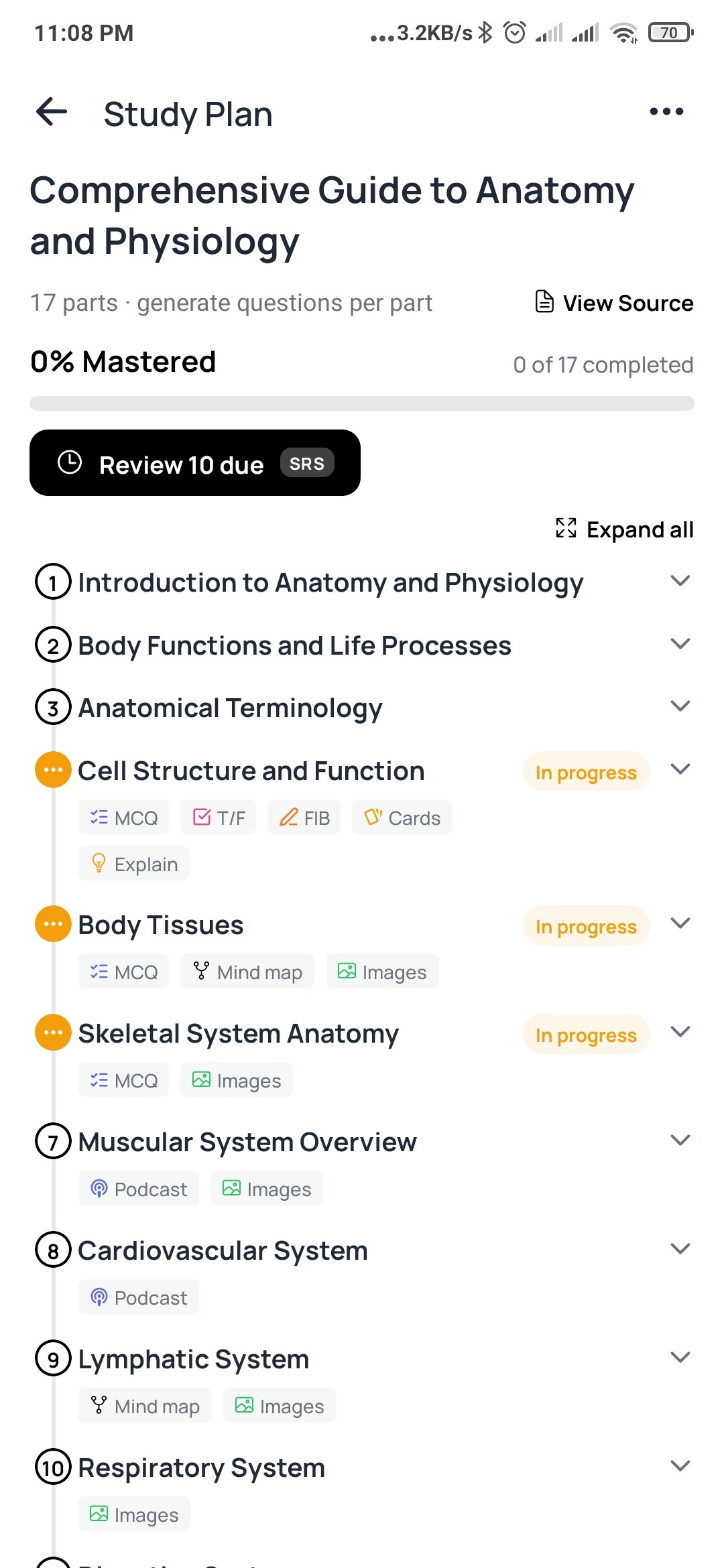
DeepRevision builds the plan for you from your actual material:
- Upload the whole textbook (or your course notes). It's split into ordered sections, each with its own pages, questions and mastery.
- Add your exam date. The plan counts down the days, works out how many minutes a day you need — shown next to the minutes you planned — and points at the next section to study.
- Each section can become practice questions, flashcards, a mind map, image labelling or a podcast.
- A page map shows which pages you've never been quizzed on, and you can fill the gap in one tap.
- Review is built in: every question you answer is scheduled with FSRS, and your plan shows the reviews due.
- The night before, Cram puts your shakiest sections first. (See how to cram for an exam.)
A sample 6-week plan
| Weeks | Focus |
|---|---|
| 1–4 | Learn 1–2 new sections a day. Clear the review queue first each session. Retry yesterday's mistakes. |
| 5 | No new material. Mixed review across all sections. Timed practice tests on your weakest topics. |
| 6 | Past papers or full mocks under exam conditions. Mistakes only. Sleep properly. |
Adjust the numbers to your exam — but keep the shape: learn with review, then review only, then exam practice.
Frequently asked questions
How far in advance should I start studying for an exam?
For a major exam, start several weeks out if you can — enough time to cover everything once and then review it at spaced intervals. The earlier you start, the less time you need per day and the more the spacing works in your favour.
How many hours a day should I study for an exam?
It depends on how much material you have and how many days are left. Work it out: total material divided by days, plus time for review. Two or three focused hours of active practice usually beat six hours of rereading.
What should a study plan include?
Every topic on the syllabus, in a sensible order, with time for first learning, time for review of earlier topics, mock exams near the end, and a buffer for days that go wrong.
What do I do if I fall behind my study plan?
Recalculate rather than give up. Work out what's left and the days remaining, drop or shrink the lowest-value topics, and prioritise the ones you're weakest on. A plan that adapts is more useful than a perfect one you've abandoned.
Sources
- Buehler, R., Griffin, D., & Ross, M. (1994). Exploring the "planning fallacy": Why people underestimate their task completion times. Journal of Personality and Social Psychology, 67(3), 366–381. doi:10.1037/0022-3514.67.3.366
- Cepeda, N. J., Pashler, H., Vul, E., Wixted, J. T., & Rohrer, D. (2006). Distributed practice in verbal recall tasks: A review and quantitative synthesis. Psychological Bulletin, 132(3), 354–380. doi:10.1037/0033-2909.132.3.354
- Gollwitzer, P. M. (1999). Implementation intentions: Strong effects of simple plans. American Psychologist, 54(7), 493–503. doi:10.1037/0003-066X.54.7.493
Stop studying everything. Study what you’re getting wrong.
DeepRevision turns your notes, slides and lectures into practice questions, finds the ones you keep missing and why, and brings each one back right before you’d forget it.
Written by
The people who build DeepRevision
We build DeepRevision, a study app that turns your own notes, slides and lectures into practice questions and brings back the ones you get wrong right before you'd forget them. We write about the research behind how students remember, and how to use it before an exam.


