How to Learn From Your Mistakes Before an Exam: The Error Log Method
Wrong answers are the most useful thing you produce while studying. Here's what the research says about errors, and a 4-step error log that turns them into marks.
Published 7 min read

Most students treat a wrong answer as a small failure: notice it, wince, read the right answer, move on. That instinct throws away the most useful information you produce all week.
A wrong answer tells you exactly where your understanding breaks — not roughly, not "I should probably revise chapter 4", but this idea, in this kind of question, under these conditions. Students who get the most out of practice aren't the ones who make fewer mistakes. They're the ones who do something systematic with every mistake they make.
This guide covers what the research says about learning from errors, the different kinds of mistakes and why they need different fixes, and a simple four-step error log you can start today — on paper or in an app.
Why mistakes are worth more than right answers
When you get a question right, you learn a little: the memory is strengthened, and you've confirmed something you already knew. When you get a question wrong and then correct it, you learn something you didn't know — and you learn it at precisely the moment your brain is primed to take it in.
Psychologist Janet Metcalfe reviewed decades of studies on this in Learning from Errors (Annual Review of Psychology, 2017). The conclusion runs against the old "errorless learning" idea that students should be protected from getting things wrong: making an error and then getting corrective feedback generally helps learning rather than hurting it, provided the feedback actually arrives.
Two findings are especially useful for exam prep.
Even a failed attempt to remember helps
In a 2009 set of experiments, Nate Kornell, Matthew Hays and Robert Bjork had learners try to answer questions before being shown the answer — attempts that mostly failed. Those learners later remembered the answers better than people who simply studied the answers for the same amount of time.
The lesson: struggling to answer, getting it wrong and then seeing the answer beats reading the answer straight away. That's a strong argument for doing practice questions before you feel ready.
Confident mistakes are the easiest to fix
You'd expect the mistakes you were most sure about to be the hardest to shift. The opposite tends to be true. In Butterfield and Metcalfe's 2001 study, errors that people made with high confidence were more likely to be corrected after feedback than low-confidence errors — the so-called hypercorrection effect. The surprise of being confidently wrong seems to make the correction stick.
Not all mistakes are the same
"I got it wrong" isn't a diagnosis. Two students can miss the same question for completely different reasons, and the fix for one does nothing for the other. Before you can fix a mistake you need to name it. These seven types cover almost everything:
| Mistake type | What it looks like | The fix |
|---|---|---|
| Conceptual | You didn't understand the idea, or understood it wrongly. | Re-learn the concept from the source, then explain it in your own words. |
| Careless | You knew it but slipped — a sign, a unit, a copied number. | Find your personal pattern and add one specific check. |
| Misreading | You answered a different question from the one asked ("NOT", "except", "per hour"). | Underline the instruction words before answering. |
| Formula / rule | You used the wrong formula, or the right one wrongly. | Write the rule out from memory and practise choosing when it applies. |
| Time pressure | You'd have got it with more time. | Timed practice; learn which question types to skip and return to. |
| Guessing | You didn't know and guessed (right or wrong). | Treat a lucky guess as a mistake — you still don't know it. |
| Overthinking | You had the right answer and talked yourself out of it. | Notice when you change answers and whether it helps you. |
That last-but-one row matters more than it looks. A correct guess is still a gap. If you count it as "right", it vanishes from your revision and comes back to bite you in the exam.
The four-step error log
An error log is just a record of your mistakes that you actually come back to. Most students who try one give up within a week because it turns into a long, unread list. The version below stays short because every entry has a job and a date.
Step 1: Capture every mistake (including lucky guesses)
Right after a practice session — not at the end of the week — write down each question you got wrong or guessed. For each one, record:
- the question (or a reference to it: "Past paper 2023, Q14")
- your answer and the correct answer
- how sure you were (high, medium, low)
Recording your own wrong answer is important. "I chose 'nerves' for the CNS" is far more useful later than "the answer is tracts", because it shows the specific confusion you need to undo.
Step 2: Diagnose the type
Give each mistake one of the seven types above. Be honest: "careless" is the most comforting label and the most overused. If you couldn't have explained why the right answer is right, it was conceptual.
Then write one line: the rule or idea that would have got you the right answer. Not the answer itself — the reason. For example: "Bundles of axons are nerves in the peripheral nervous system and tracts in the central nervous system."
Step 3: Fix it at the right level
Match the fix to the type:
- Conceptual mistakes need you to go back to the source — the textbook page or lecture slide — rather than just reading the explanation in the answer key. Then close the book and explain the idea out loud, as if teaching a friend. If you can't, you haven't fixed it yet.
- Careless and misreading mistakes need a habit, not more content. Look across your log: do they cluster? Many students find one or two repeat offenders (dropped negatives, ignored units). Add a specific check for that to the end of every question.
- Time-pressure mistakes need timed practice with the same question types.
Step 4: Schedule the retry — then retry
This is the step almost everyone skips, and it's the one that makes the log work. Reading the explanation creates a feeling of understanding that fades within days. The only proof a mistake is fixed is getting the question right on a later day, without help.
Give each entry a retry date: a day or two later first, then (if you got it right) a week later, then a few weeks after that. This is spaced repetition applied to your mistakes — the gaps grow each time you succeed, and shrink back if you slip.
A simple rule: a mistake leaves your log only after you've got it right on two separate later days.
Look for patterns, not just individual errors
After a couple of weeks, step back and read your log by topic and by type. You're looking for clusters:
- By topic: 12 mistakes in "acid–base" and 1 in "kinetics" is a revision plan. Your accuracy per topic is a better guide to where to spend time than how confident you feel.
- By type: if half your mistakes are misreading, more content won't help; slowing down on the question stem will.
- By confidence: a run of high-confidence errors in one topic means you've learned something wrong — those are worth fixing first (and, thanks to hypercorrection, they're often quick to fix).
Doing it on paper vs in an app
A paper or spreadsheet log works, and the act of writing each entry is useful in itself. Its weaknesses are practical: it takes time to keep up, it's hard to sort by topic, and nothing reminds you when a retry is due — so most logs quietly stop being used.
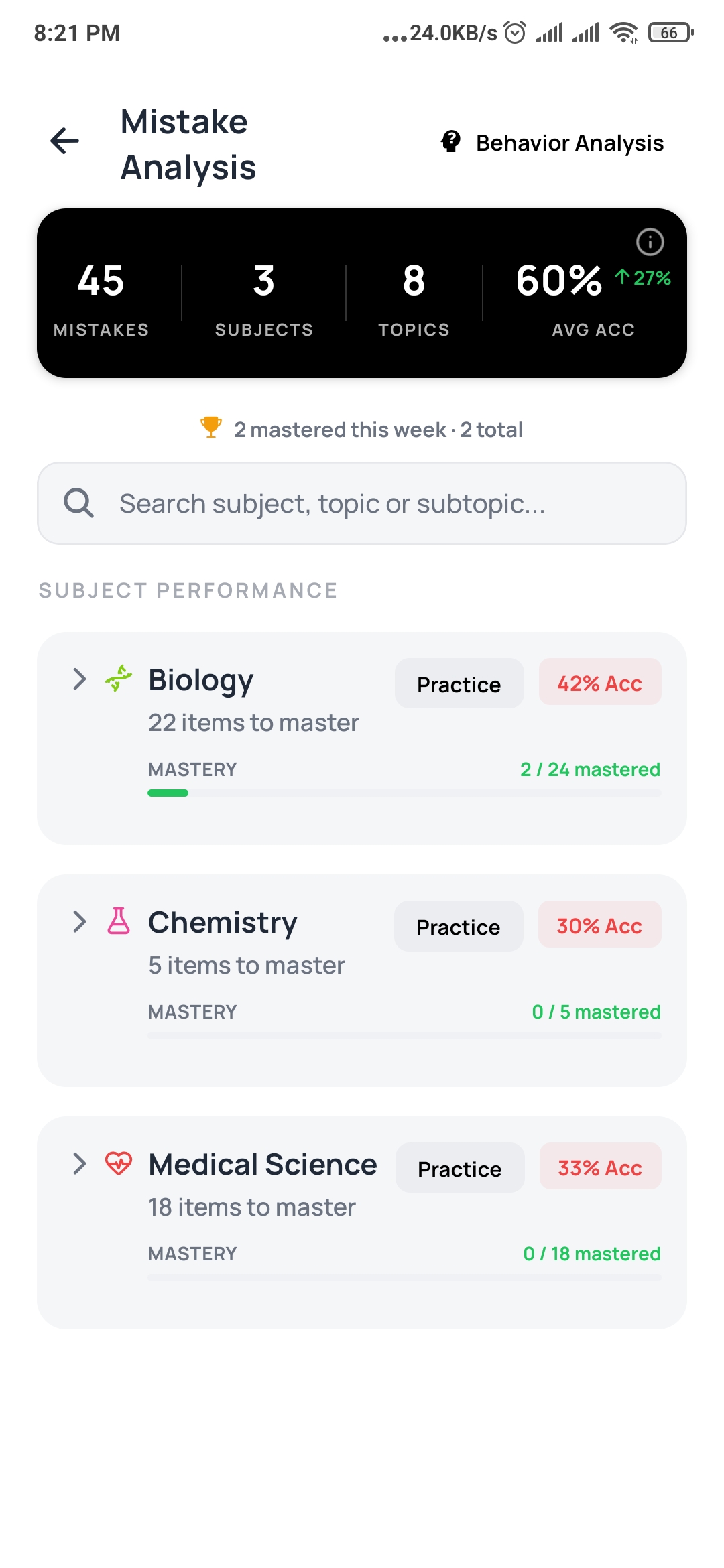
This is the problem DeepRevision was built around. When you practise questions written from your own notes, slides or textbook:
- every wrong answer is kept automatically — your answer, the correct one, every attempt and how long you took
- mistakes are filed by subject, topic and subtopic, with your accuracy at each level
- each mistake is labelled with how it went wrong (conceptual, careless, time pressure, misreading, formula, guessing or overthinking)
- you can ask the AI why you missed it and the right way to think about it, or pull up a video tutorial for that exact question
- every question is scheduled for review with the FSRS algorithm, so a mistake comes back right before you'd forget the correction
A one-week plan to start
You don't need to rebuild your whole revision. Try this for one week:
- Day 1: Do one set of practice questions on a topic you think you know. Log every mistake and guess.
- Day 2: Diagnose each entry and write the one-line rule. Retry yesterday's mistakes without looking.
- Days 3–6: Keep practising new material. Each day, start with the retries that are due.
- Day 7: Read your log by topic and by type. Pick the biggest cluster and spend one session fixing it at the source.
By the end of the week you'll know more about how you lose marks than a month of rereading would tell you. That's the point: stop studying everything, and study what you're getting wrong.
Frequently asked questions
Is it bad to make mistakes while studying?
No. Research on learning from errors shows that getting something wrong and then seeing the correct answer often leads to better memory than never being tested at all. The mistake is only wasted if you move on without checking why it happened.
What should an error log include?
At minimum: the question, your answer, the correct answer, the type of mistake (concept, careless, misread, time pressure and so on), the rule or idea you should have used, and the date you'll retry it. The retry date is what most error logs leave out.
How often should I review my mistakes?
Retry each mistake a day or two after you make it, then again at growing gaps — for example after a week and after a few weeks. A question is fixed when you get it right on a later day without help, not when you understand the explanation.
How do I stop making careless mistakes in exams?
Log them like any other mistake and look for a pattern. Careless errors usually cluster — dropping negative signs, misreading 'not', skipping units. Once you know your pattern, add one specific check for it to the end of every question.
Sources
- Metcalfe, J. (2017). Learning from errors. Annual Review of Psychology, 68, 465–489. doi:10.1146/annurev-psych-010416-044022
- Kornell, N., Hays, M. J., & Bjork, R. A. (2009). Unsuccessful retrieval attempts enhance subsequent learning. Journal of Experimental Psychology: Learning, Memory, and Cognition, 35(4), 989–998. doi:10.1037/a0015729
- Butterfield, B., & Metcalfe, J. (2001). Errors committed with high confidence are hypercorrected. Journal of Experimental Psychology: Learning, Memory, and Cognition, 27(6), 1491–1494. doi:10.1037/0278-7393.27.6.1491
Stop studying everything. Study what you’re getting wrong.
DeepRevision turns your notes, slides and lectures into practice questions, finds the ones you keep missing and why, and brings each one back right before you’d forget it.
Written by
The people who build DeepRevision
We build DeepRevision, a study app that turns your own notes, slides and lectures into practice questions and brings back the ones you get wrong right before you'd forget them. We write about the research behind how students remember, and how to use it before an exam.


