How to Turn Your Notes Into a Study Podcast (and Actually Learn From It)
Listening on the bus can be real revision — if you do it right. How to turn notes, chapters and even your mistakes into a study podcast, and how to make listening stick.
Published 4 min read

Most students have hours every week they can't use for studying: the bus, the walk to campus, the gym, washing up. You can't do practice questions on a crowded train. But you can listen.
A study podcast — your own material turned into audio — can make that time count. The catch is that listening is a fairly passive activity, and passive activities fade fast. This guide covers how to turn your notes into a podcast, and the habits that make the listening actually stick.
Why audio works (and where it doesn't)
Hearing material explained in a conversational way helps in a few specific situations:
- First exposure. Listening to a topic before you study it gives you a rough map, so the textbook makes sense faster.
- Refreshing between sessions. A 10-minute episode on yesterday's chapter keeps it warm.
- Hearing it explained differently. A question-and-answer format often surfaces the "why" that a dense textbook skips.
But be honest about the limits. Listening is closer to rereading than to testing yourself — and in the large review of study techniques by Dunlosky and colleagues (2013), rereading was rated low utility, while practice testing was rated high utility. Information that goes in passively mostly comes back out again.
So the goal isn't to replace practice with podcasts. It's to use time you'd otherwise waste — and then make sure the listening is followed by testing.
Three ways to make a study podcast
1. Record yourself explaining (free, powerful)
Open your phone's voice recorder and explain a topic out loud, as if to a friend, without reading your notes. Then listen back later.
This is two study sessions in one: explaining from memory is a form of retrieval practice (and the core of the Feynman technique), and listening back reveals the bits you stumbled over.
Drawback: it only covers what you already understand, and hearing your own voice takes getting used to.
2. Text-to-speech of your notes (free, flat)
Most phones and computers can read a document aloud. It's free and fast, but listening to notes read in a monotone is hard to concentrate on, and bullet-point notes make terrible audio.
3. An AI-generated conversation (fast, engaging)
AI tools can now turn a document into a spoken conversation between two voices. This is the most listenable format by far: one voice asks the questions a student would ask, the other explains. It's closer to overhearing a good tutorial than reading a textbook aloud.
Making a podcast in DeepRevision
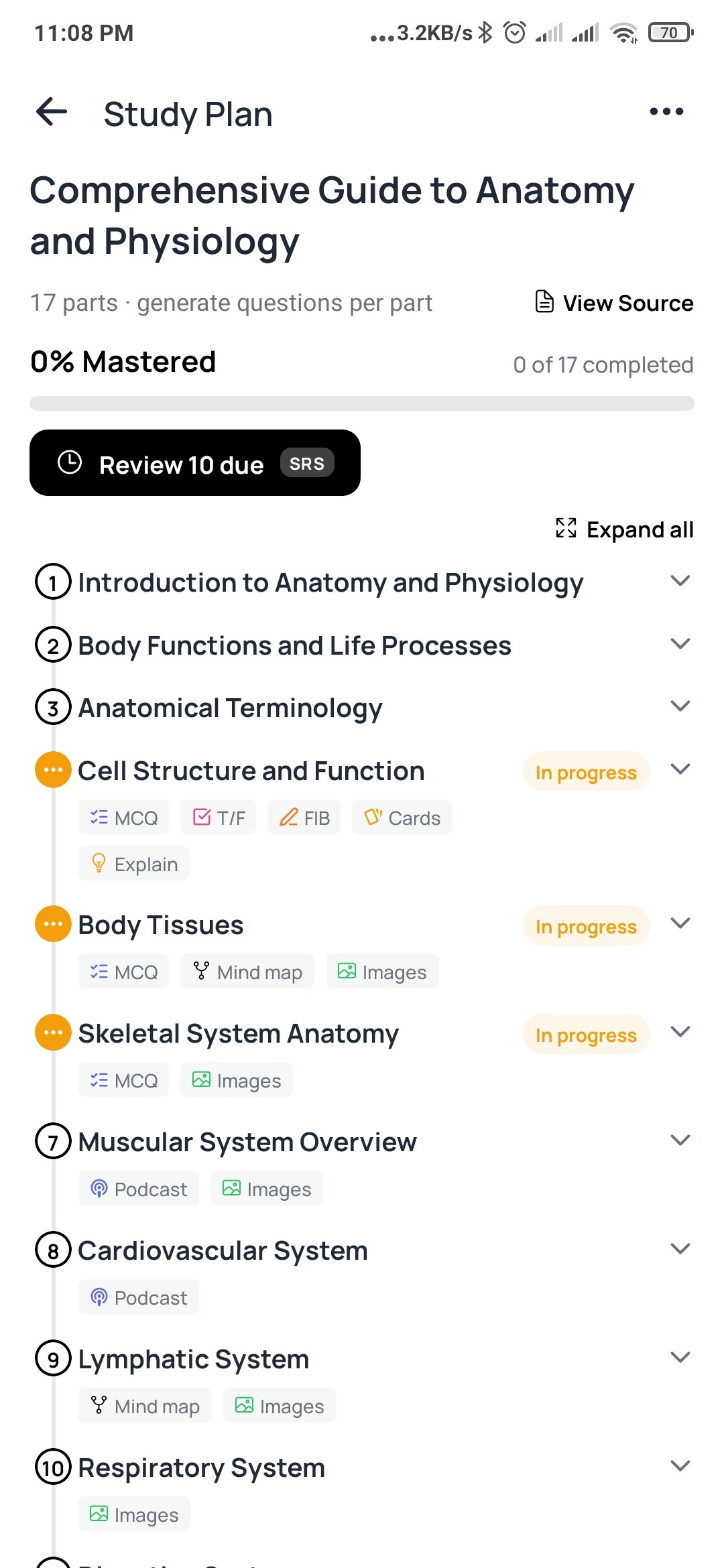
DeepRevision turns any topic into a two-voice podcast. Nova, the curious student, asks. Alloy, the tutor, explains. You can make an episode from:
- a topic you type in
- a chapter of your study plan — so the episode covers exactly the pages you're studying
- your own mistakes — an episode built around the questions you got wrong, which is the most useful revision audio you can have
While it plays, the transcript highlights each sentence as it's spoken, so you can read along at your desk or glance at a term you didn't catch. And you can download an episode and listen offline on the way in.
How to make listening stick
Pause and answer
When the student voice asks a question, pause and answer it out loud before the tutor does. This one habit converts passive listening into retrieval practice. It's the single best thing you can do with a study podcast.
Listen before, test after
Use an episode as a preview before a study session, or a refresher the day after. Then, at your desk, answer practice questions on the same material. The podcast makes the questions easier to engage with; the questions make the podcast's content stick.
Make episodes from your mistakes
An episode built around the questions you got wrong is targeted in a way no general podcast can be. It revisits your exact confusions, in a format you can use while walking.
Keep episodes short
Ten to fifteen minutes is enough. Attention drifts after that, and short episodes are easier to fit into real gaps in your day.
Don't count it as study time
Be honest in your plan: a commute podcast is a bonus, not a session. If you count three hours of listening as three hours of revision, you'll arrive at the exam with far less practice than you think.
A sample week with audio
| When | What |
|---|---|
| Morning commute | Podcast on today's new section (preview). |
| Desk session | Read the section, then practice questions on it. |
| Evening walk | Podcast on yesterday's mistakes. |
| Weekend | Review queue, then one episode per weak topic. |
Done this way, the hours you used to lose to the bus become a steady drip of review — and the questions at your desk do the heavy lifting.
Frequently asked questions
Can you really learn by listening to a podcast?
Yes, but listening on its own is closer to rereading than to testing yourself, so it fades quickly. It works best as a first pass before you study or a refresher between sessions — followed by questions on the same material.
How do I make a podcast from my notes?
You can record yourself reading or explaining your notes, or use an AI tool that turns a document into a spoken conversation. The best results come from a two-voice format where one voice asks questions and the other explains.
Is it better to listen to study podcasts at higher speed?
Modest speed-ups (around 1.25×) are usually fine for familiar material. For new or difficult topics, normal speed and a pause to answer the questions in your head are worth more than finishing faster.
When is the best time to listen to study podcasts?
Time you can't use for anything else: commuting, walking, exercise, chores. Use your desk time for the active work — practice questions and explaining — and let audio fill the gaps.
Sources
- Dunlosky, J., Rawson, K. A., Marsh, E. J., Nathan, M. J., & Willingham, D. T. (2013). Improving students' learning with effective learning techniques. Psychological Science in the Public Interest, 14(1), 4–58. doi:10.1177/1529100612453266
Stop studying everything. Study what you’re getting wrong.
DeepRevision turns your notes, slides and lectures into practice questions, finds the ones you keep missing and why, and brings each one back right before you’d forget it.
Written by
The people who build DeepRevision
We build DeepRevision, a study app that turns your own notes, slides and lectures into practice questions and brings back the ones you get wrong right before you'd forget them. We write about the research behind how students remember, and how to use it before an exam.


