Active Recall: The Study Method That Beats Rereading (and 6 Ways to Use It)
Active recall means testing yourself instead of rereading. Here's what the research shows, why it feels harder but works better, and six practical ways to use it.
Published 4 min read

There's a cruel twist in how studying feels. The methods that feel most productive — rereading your notes, highlighting, watching the lecture again — are among the least effective. And the method that feels hardest, because it keeps showing you what you don't know, is one of the most effective there is.
That method is active recall: studying by pulling information out of your memory, rather than putting it in again.
What active recall is
Active recall (or retrieval practice) is any study activity where you produce the answer from memory before checking it:
- answering a practice question without looking
- covering a diagram's labels and naming the parts
- writing down everything you remember about a topic
- explaining a concept out loud with your notes closed
The opposite is passive review: rereading, highlighting, copying notes neatly, watching a video again. You're re-exposed to the material, but you never have to retrieve it.
What the research shows
The testing effect is one of the most replicated findings in learning science.
- In Roediger and Karpicke (2006), students who read a passage and then took recall tests remembered substantially more after two days and after a week than students who reread the passage — even though the rereaders did slightly better on a test five minutes later.
- In Karpicke and Roediger (2008), once students had learned a list of foreign-language words, continuing to test them led to far better recall a week later, while continuing to study them added almost nothing.
- When Dunlosky and colleagues (2013) reviewed ten common study techniques, practice testing was one of only two rated high utility. Rereading and highlighting were rated low.
Even failed recall helps: Kornell, Hays and Bjork (2009) showed that trying to answer before seeing the answer — and getting it wrong — still led to better learning than just studying the answer.
Why it feels worse but works better
Rereading creates fluency: the words feel familiar, so your brain concludes it knows them. But recognising something on the page is a different skill from producing it in an exam.
Active recall exposes the gap. It's uncomfortable because it's honest. Psychologists call this kind of productive struggle a desirable difficulty: harder in the moment, better for the long term.
6 ways to practise active recall
1. Practice questions
The most direct form. Multiple choice is quick; fill-in-the-blank and short answer are stronger because you produce the answer rather than recognise it. Past papers are ideal near the exam. (Our guide on turning a PDF into a practice test covers how to make your own.)
2. Flashcards — done properly
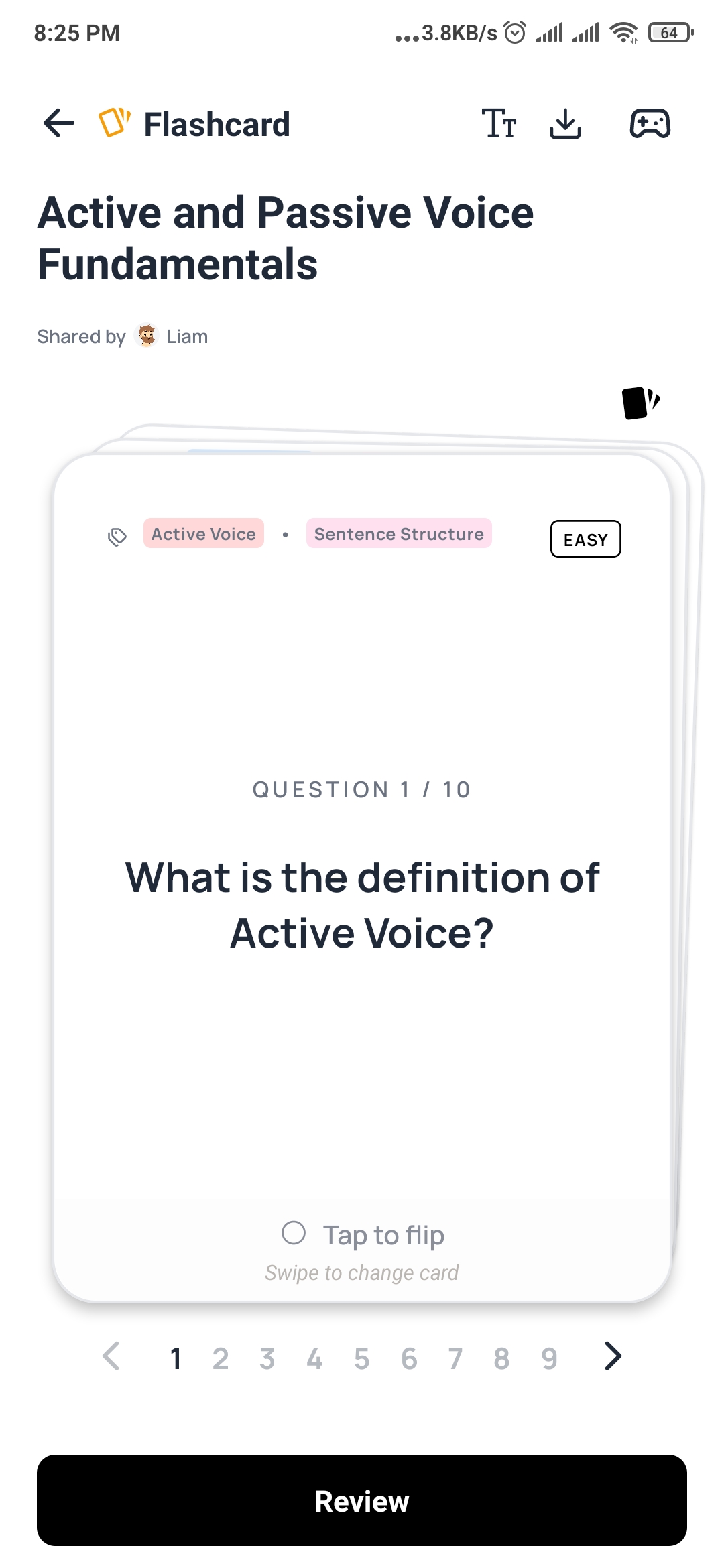
Say the answer before you flip the card. If you flip first and think "yeah, I knew that", it's not recall. Keep one idea per card.
3. The blank page (brain dump)
Close everything and write down all you remember about a topic: facts, diagrams, connections. Then open your notes and fill the gaps in a different colour. The gaps are your revision list.
4. Label diagrams from memory
For anything visual — anatomy, geography, circuits — cover the labels and name or locate each part. See how to study anatomy.
5. Explain it out loud
Teach the concept to an imaginary beginner without notes. Where you stumble is where you don't understand. This is the Feynman technique.
6. Questions in the margin
As you take notes, write a question next to each section. Later, cover the notes and answer the questions — the Cornell note-taking layout is built around this.
Make active recall work long-term
Active recall is powerful on its own. Combined with two other habits, it's the backbone of efficient studying:
- Spacing. Test yourself again on later days, at growing gaps. One session of questions fades; repeated sessions at the right moments last. That's what spaced repetition algorithms like FSRS schedule for you.
- Feedback on mistakes. Check every answer, and keep the ones you got wrong. Those are your most valuable questions. (See learning from your mistakes.)
Active recall in DeepRevision
DeepRevision is built around active recall. Upload your notes, slides, a PDF or a lecture, and it writes questions from them in six formats: multiple choice, true or false, fill in the blanks, matching, flashcards and image labelling.
- Practice mode explains each answer as you go, with the page the question came from.
- Exam mode is timed and silent, and marked at the end — nothing is given away.
- A question only counts as mastered after you get it right three times in a row, so one lucky answer doesn't fool you.
- Every question is scheduled for review with FSRS, and every wrong answer goes into your mistake analysis.
A simple active recall routine
- Learn a section (read it once, carefully).
- Close it and do a brain dump or answer 10–15 questions.
- Check every answer and note the misses.
- Tomorrow, answer the misses again, plus a few you got right.
- Keep going at growing gaps until each question is reliably right.
It will feel harder than rereading. That's the point.
Frequently asked questions
What is active recall?
Active recall is studying by retrieving information from memory — answering a question, filling a blank, explaining from memory — instead of reading or highlighting it again. Psychologists call it retrieval practice.
Is active recall better than rereading?
Yes. In controlled studies, students who tested themselves remembered substantially more days and weeks later than students who spent the same time rereading, even though rereading felt more effective at the time.
How long should an active recall session be?
Short and frequent beats long and rare. 20–40 minutes of focused questions on one topic, repeated on later days, is more effective than a single long session.
Do I need to get the answers right for active recall to work?
No. Attempting to recall something and failing, then seeing the answer, still improves learning. What matters is that you try before you look, and that you check the answer afterwards.
Sources
- Roediger, H. L., & Karpicke, J. D. (2006). Test-enhanced learning: Taking memory tests improves long-term retention. Psychological Science, 17(3), 249–255. doi:10.1111/j.1467-9280.2006.01693.x
- Karpicke, J. D., & Roediger, H. L. (2008). The critical importance of retrieval for learning. Science, 319(5865), 966–968. doi:10.1126/science.1152408
- Dunlosky, J., Rawson, K. A., Marsh, E. J., Nathan, M. J., & Willingham, D. T. (2013). Improving students' learning with effective learning techniques. Psychological Science in the Public Interest, 14(1), 4–58. doi:10.1177/1529100612453266
- Kornell, N., Hays, M. J., & Bjork, R. A. (2009). Unsuccessful retrieval attempts enhance subsequent learning. Journal of Experimental Psychology: Learning, Memory, and Cognition, 35(4), 989–998. doi:10.1037/a0015729
Stop studying everything. Study what you’re getting wrong.
DeepRevision turns your notes, slides and lectures into practice questions, finds the ones you keep missing and why, and brings each one back right before you’d forget it.
Written by
The people who build DeepRevision
We build DeepRevision, a study app that turns your own notes, slides and lectures into practice questions and brings back the ones you get wrong right before you'd forget them. We write about the research behind how students remember, and how to use it before an exam.


